
Celebrating my freedom from Mark Zuckerberg & Co.
Originally published in Illumination on July 15, 2022.
This is is a followup to my open letter, published on Illumination on June 27.
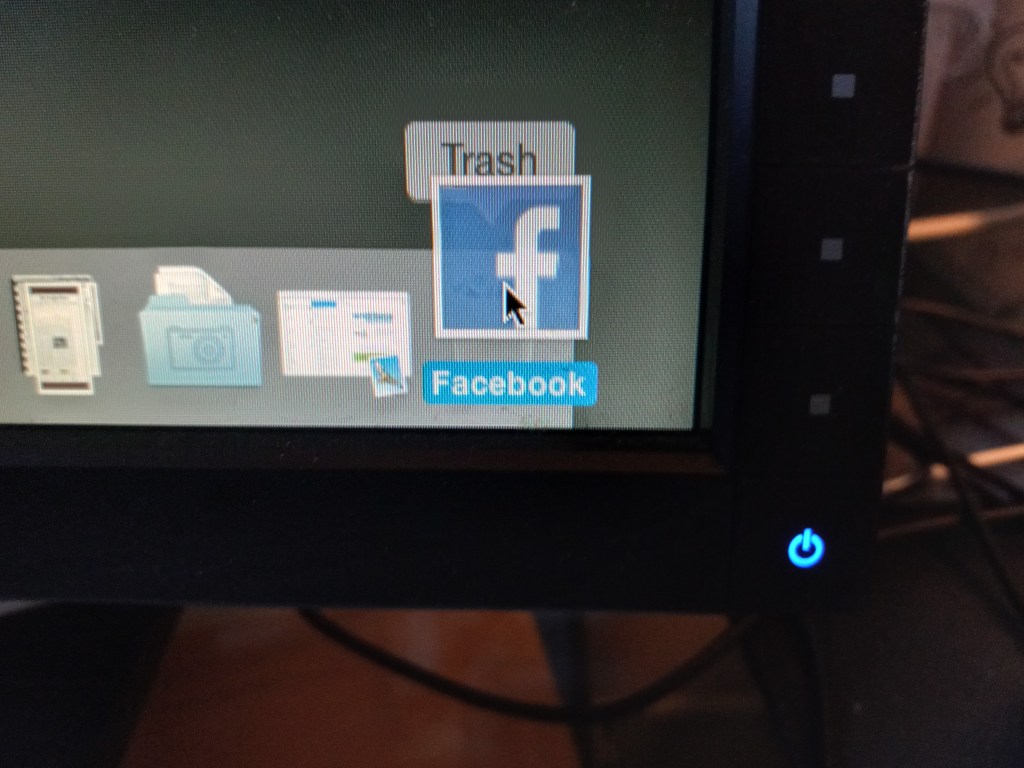
It’s July 14, 2022, Bastille Day — almost two weeks since escaping fortress Facebook and heading on the road toward social media freedom. It was on my own country’s national day — July 1, Canada Day — that Facebook Protect locked me out of my account. Facebook called my bluff and marched through my digital portal, like unwanted Trojan condom stormtroopers forcing people to practise safe sex, and decided to protect me from all the hackers of the world.
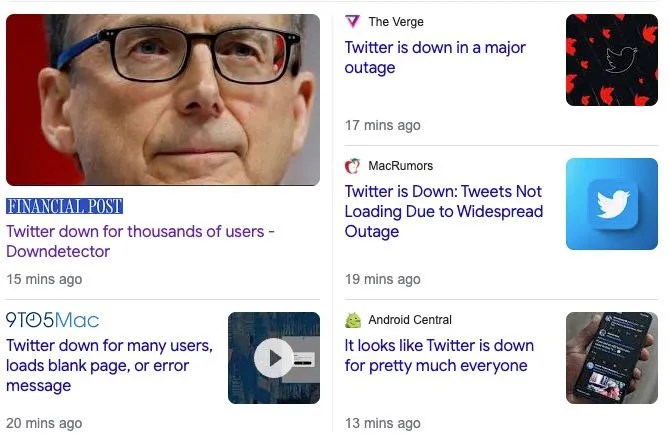
It’s been a mostly liberating experience although I haven’t abandoned social media entirely. I still have LinkedIn, which Jaron Lanier had to admit has “the fewest assholes” of all the large social networks. And I gotta say, I still like Twitter although today it’s proving it can be as unreliable as Facebook, Rogers and other tech giants sometimes.
As I explained in my original post, there’s a lot I didn’t like about Facebook and the way they forced Facebook Protect on select users like me. Since I was locked out, I have had other questions and concerns — like why other friends can see my account, post on my wall and message me while I’m locked out — and I’ve asked Facebook for answers.
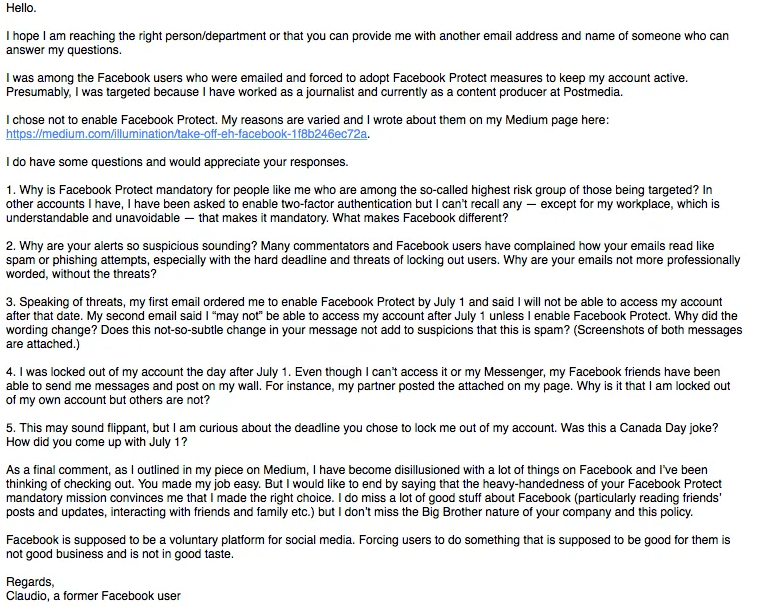
Not surprisingly, they have not responded to my query to their press@fb.com account, with copies to security@facebookmail.com and Zuckerberg himself. According to this account back in 2016, with 1.6 billion active monthly users on Facebook (it’s probably closer to three billion now), if only .1% of these people reached out once per month, that would be 1,600,000 tickets for a company with only 13,598 employees at the time.
So my freedom from Facebook seems to be forever and that suits me just fine. I’ve never Meta another social medium that has frustrated me as much as Facebook.
And the irony in locking me out is that while Facebook claims they are protecting journalists, their business has been bleeding my profession of ad dollars for years. That’s why Canadian publishers have been pushing my government to pass Bill C18 which will allow them to negotiate with the likes of Facebook and Google for more digital dollars when they use their content.
Even so, while I compare my freedom from Facebook addiction to quitting smoking, I agree with Lanier that social media isn’t entirely harmful, like tobacco. The better analogy would be to lead paint where the likes of Facebook could still prove useful and beneficial if purged of the poison of manipulation, just as paint was of lead. I just don’t have faith that Facebook’s business model will allow for any substantial reforms.
Meanwhile, I’ve been thinking about the pros and cons of other social media — in particular Twitter.
Twitter, for its warts, has been a platform I’m naturally drawn toward which makes sense as it draws a lot of journalists.
I compare Twitter to a waterfall and Facebook to a lake. With Twitter, the interactions and information cascades onto you whereas with Facebook, it feels like you’re surrounded by friends, ads and sponsored posts lapping up against you.
I have more real friends and family on Facebook so there were a lot more engagements there and they tended to be more personal. On Twitter, I have far fewer followers and they’re mostly strangers so it can feel a bit impersonal.
But Twitter does include communities of sort, such as the @RushFamTourneys group of fans of the rock group Rush where I’ve enjoyed many interactions and fun exchanges with people from all over the world. Twitter’s Montreal Canadiens fanbase is another example of a robust, mostly healthy community of fan followers.
I also like how Twitter can connect you with strangers and even the famous. For instance, one of my recent tweets about the documentary Kurt Vonnegut: Unstuck in Time got a reaction and a thank you from the filmmaker Robert B. Weide of Curb Your Enthusiasm fame. There have been others, including well-known people I admire and respect, who have liked, commented and even joined my modest following on Twitter.
But it’s like the wild wild west of social media where anyone can be a follower, unless you block them, and you can get random follows from some creepy bot-like characters. (You know, the ones who have three followers and follow 343 people, and enjoy showing off their body parts.) Twitter has also had its fair share of fake news, crazy conspiracy theories and kooks and we all know how Donald Trump used it as his personal bully pulpit.
Curious about the differences in the two social media platforms, I reached out to a friend and former editor who goes by the Twitter handle @tincanman2010 and is a heavy user in that space. We’ve enjoyed many interactions in the Twittersphere over the years, including a shared love of music and puns.
While he said he wouldn’t be surprised at promoted tweets, he doesn’t see anywhere near the kind of data harvesting and privacy intrusions that are on Facebook. He also doesn’t think the people who work at Twitter feel that empire building is part of their raison dêtre. What he says about Facebook, however, is this:
“I think FB is insidious and if people knew the extent of its harvesting they would be aghast. Anything I do on FB is fair game; that’s the subscription fee. But FB harvests non-FB data from your PC and web activities, and if that isn’t illegal I don’t know why. ”
He calls Twitter a “constant companion” and says as a social medium, making connections is good for our mental health, however fleeting and superficial they are.
“That’s why phone-in radio shows were popular. They are no substitute for real-life relationships of course, but I think Twitter has shown we need both.”
But Twitter can also be a “harsh mistress,” he warns, showing the worst and best in us.
“As soon as you begin to rely on it to cheer you up or find you friends, it’ll turn on you.”
He has learned to block “mean people and rabble-rousers” and finds blocking keywords helps limit the firestorm of topics he sees. He can say something witty or intelligent to make somebody’s day better, or will “‘correct’ someone’s thinking and make my own day.”
But like all social media, including the one I left behind, he reminds us that we’re all just occupying temporary parking spots in these spaces and we ultimately don’t matter. That’s a harsh reality.
“The key thing I learned or realized early on is there’s millions of people on Twitter, and we’re all expendable. People come, you share a moment or seven, people go. If you drop someone or they drop you, the 24/7 churn of Twitter will spit out someone new.”
For now, I think I’ll continue with Twitter and LinkedIn in the hopes of minimizing the digital manipulation in my life. As for Facebook, I’ll admit it’s a weird feeling, not being part of that world and experiencing a little bit of FOMO. I feel like Alice Cooper in his song “Going Home,” wondering,
“if anyone missed me,
or have I been gone so long
they thought that I died.”
Have any of my Facebook friends wondered what happened to Claudio? How many shrugged? Laughed? How many cried?
“But I don’t give a damn!
’cause I’m going home.”


 Claudio D'Andrea
Leave a comment