
A review of Kristen Roupenian’s “The Good Guy” and Karen Joy Fowler’s Black Glass
Claudio D’Andrea illustration of New Yorker illustration of Eustace Tilley.
Originally published in Curiosity Never Killed the Writer on March 12, 2019.
I recently read back-to-back short fiction works: the story “The Good Guy” by Kristen Roupenian, whose “Cat Person” in the New Yorker went viral in 2017, and Black Glass, the 1998 work of short fiction by Karen Joy Fowler. I read the first story because my brain was engulfed by all the buzz about Roupenian. The second book sounded intriguing and, well, at $5 in the Bargain Books section of the local Indigo store, I couldn’t resist.
This is a tale of two writers. Admittedly, I haven’t read more of either Roupenian or Fowler to pass this assessment off as expert, but there was enough material to hint at the talents of the respective authors.
My conclusion is that Fowler can write. And Roupenian writes like shit — at least in parts.
I’m just focusing on the writing here, not the subject matter, characters, plot, theme or any other element that makes for a great story. I wanted to know about the quality of writing by someone who has reaped a seven-figure book deal bonanza. I read this opening paragraph of “The Good Guy” and continued on to the end for the next hour, feeling a little like the guy who falls for an anonymous email message from someone who says I have a rich uncle in Nigeria:
“By the time he was 35, the only way Ted could get hard and remain so
for the duration of sexual intercourse was to pretend that his dick was a
knife, and the woman he was fucking was stabbing herself with it.”
Well, that’s certainly a shocking image and I’m not prudish enough to turn away from a writer that uses such loaded language. After all, I thought, this wasn’t Fifty Shades of Grey. I was reading an author who was published in the venerable New Yorker. This had to be good!
Her next paragraph:
“It’s not like he was some kind of serial killer. Blood held no erotic charge for him, either in fantasy or in real life. Key to the scenario, moreover, was the fact that the woman was choosing to stab herself: The idea was that she wanted him so badly, had been driven so wild with obsessive physical desire for his dick, that she was driven to impale herself on it despite the torment it caused. She was the one taking the active role; he just lay there as she thrashed around on top, doing his best to interpret her groans and facial twitches as signs that she was being crushed in an agonizing vise between pleasure and pain.”
You’re fooling yourself Ted, I thought. You may not be a serial killer but you’ve got some serious fucked-up shit going on in that head.
I read on. I figured perhaps Roupenian was only describing Ted’s own misguided self-assessment — or that of Angela (a professional, mature woman who ends up behaving like a soft-headed teen in her dealings with Ted) and just focused on the quality of the writing.
I read about Ted and a new crush, Anna, in a scene around a campfire:
“He unrequitedly loved Anna; Anna unrequitedly loved Marco; Marco probably unrequitedly loved some rando none of them had ever met.”
Rando — is that an autocorrect thing? Or maybe Roupenian presenting the word as the lingo of a hipster teen. But…teens don’t use “unrequitedly” and Ted’s a grown man in the present day.
Then I read this description of Ted recalling his first kiss with Rachel:
“A hammer of shame swung down and flattened him. Dorky, know-it-all Rachel, condescending to teach him how to kiss!”
A what of what did what to Ted? Did Medium auto-correct Roupenian’s writing there? I wondered again. There’s no way a writer who isn’t E.L. James would write anything as bad as that!
I soldiered on. Roupenian gives Ted’s reaction to the kiss: “Rachel’s breath smelled like popcorn butter: slightly metallic, with a hint of the burnt grease that stuck to the bottom of the machine.” That’s pretty good, I thought, and kept reading.
Alas, there soon came this line: “If before he’d felt like his dick had crawled up inside his body, now he felt like a two-ton lead slab had dropped on his crotch from the heavens, paralyzing him for life.”
There isn’t enough room on the Dynamic Periodic Table to fit the hyperbole of such a stratospheric element.
As Rachel is about to depart from Ted’s sordid little world — claiming surprise that he would break up with her after agreeing to visit her cousin (?!) — Roupenian gives us this line which reads like it came out of a teen’s fan blog:
“Well, what if she did, Ted? What. If. She. Did. Couldn’t he have just shrugged his shoulders and said, “Whelp, sucks for your cousin, I changed my mind”?
Juvenile single-world sentences were hackneyed even when they were new. Today, they revolt the intelligent reader.
I could go on like this, cataloguing Roupenian’s bad writing examples, but you get the picture. If not, there’s a listing of clichés and dumb lines at the end of this review.
***
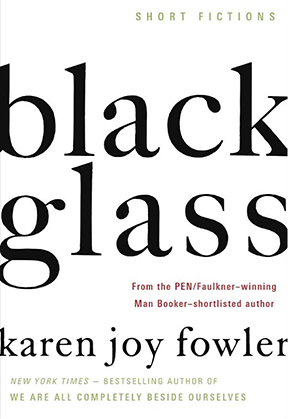
It doesn’t take long, reading the title story in Black Glass, to realize you’re in the hands of a masterful stylist. Karen Joy Fowler is describing the scene inside the Senate Bar, with its marble and black onyx floor, curved counter and a proprietor “stroking the shot glasses,” in this fantastical tale:
“The bar was starting to metamorphose around him. The puddles of liquor on the floor sprouted into fountains, green liquid trees of crème de menthe, red trees of wine, gold trees of beer. The smell of liquor intensified as the trees bloomed. They grew flowers and dropped leaves in the liquid permanence of fountains, an infinite, unchanging season that was all seasons at once.”
Or consider “Letters from Home,” with this visceral description of a Vietnam soldier’s apprehension as his plane is about to descend into that country:
“The immediate threat is the plane’s descent. You make a sudden decision not to descend with it. You spread your arms to hold yourself aloft. You hover near the top of the plane. But it is hopeless. If they have to shoot you down, they will. Friendly fire. You return to your seat. The plane carries your body down into Vietnam.”
Later in that story, one character prepares a dish of pasta, lining a pan with cannelloni in neat rows. “Little corpses,” Fowler writes.
In “Duplicity,” an astonishing story about two women imprisoned by aliens, Fowler describes one of them opening a box of tampons. “Alice picked one up, holding it by its long tail like a dead mouse.”
In the same story, the writer uses the imagery of the land to great effect. Alice sleeps soundly, Fowler writes, and she seldom moves: “her body was landscape.” Later, we learn that she was “only interested in the terrain” of the land, not the inhabitants.
In this land, the river “drummed,” birds cry, male howler monkeys roar and bugs “rattled and clicked,” Fowler writes.
“How quickly the forest accepted an alien presence. It was like a knife plunging into water; the water re-formed instantly about the blade, the break was an illusion.”
“Duplicity,” like several other stories in this collection, also examines the battle of the sexes but Fowler does it in a more mature, believable way. The metaphorical knife she wields is poetic, original and beautiful — not an imagined male member slashing the inside of a woman.
***
The two writers presented here are a random selection. I only chose to contrast Roupenian and Fowler as a cautionary tale to not get swept away by the literary flavour of the day and focus instead on what makes for great writing: It’s great writing.
Fowler, despite the rare weird wordsmithing — “Sex came between us again,” in “The Brew” comes to mind — knows how to write. Roupenian’s writing sometimes reads like teen fan fiction.
Which is baffling considering how she was embraced by one of the world’s greatest magazines and is praised in reviews everywhere.
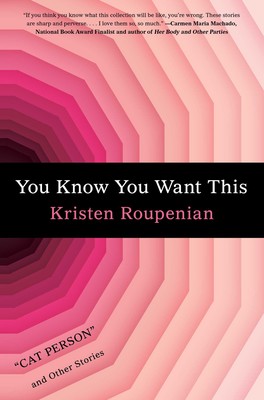
Kirkus Reviews lauds the “cultural phenomenon” in the 12 “visceral stories” in Roupenian’s debut collection You Know You Want This as a “combination of impossibly sharp writing and impossibly good timing,” a reference to the #MeToo movement. NPR argued, “By any metric — craftsmanship, intelligence, addictiveness — Roupenian’s stories are excellent.” The New Republic also noted the “well-timed (though no-less-well-written) “Cat Person,” but does concede “the occasional whoopsie-doodle of a cliché” in her writing.
Vanity Fair’s Nancy Jo Sales’s caustic observation that” “Basically anyone who’s ever used a dating app could write Cat Person, just maybe not as well” is quoted in a response from The Guardian’s Kaite Welsh who tries to make a case for Roupenian as the new Jane Austen: That somehow, the negative responses to “Cat Person” are an example of a “distaste for women’s writing” and “misogyny.”
Rubbish. I don’t take issue with Roupenian’s subject matter and I certainly don’t have a problem with women’s writing. Consider Karen Joy Fowler on the matter: In her “The View from Venus: A Case Study,” one of the stories in Black Glass, characters offer intelligent commentary on “women’s writing” using the example of Austen and Joseph Conrad.
One of those characters, Ben, notes patronizingly: “Women’s writing is restricted because women’s lives have been restricted. They’re still capable of writing well-crafted little books.”
I certainly don’t think women are capable of writing only “little books,” well-crafted or not. And I’m not a “crotchety old guy who sniffs at stories about women” that Roupenian disparages.
But some of the stuff I did sniff in “The Good Guy” smelled like shit.
Some of the really bad stuff from “The Good Guy”
Kristen Roupenian’s “The Good Guy” includes cliches, silly lingo, mixed metaphors and other bad writing. Here is a motley assortment, with some wry observations (in italicized parenthesis):
- Ted’s girlfriend Angela was “way out of his league.”
- She would enjoy “performing a happiness” for Ted.
- Ted worried if he could ever make Anna like him “like a dog working the last bits of marrow from a bone.”
- The thought of Rachel being attracted to Ted “made him feel fantastically light, like some sponge inside him, heavy with poison, had finally been wrung dry.”
- Ted realizes if Rachel “flew off the handle” and gave him an ultimatum about Anna, he would have to break up with her.
- “The problem was that he didn’t just want to find out if Rachel’s story was true; he needed to find out — his itch to know felt like bugs crawling under his skin.”
- “As Anna poured her heart out over the phone, Ted’s own heart lit up like a solar flare.”
- “And then, when Anna’s silence indicated that cackling like a madman was an insufficient response, he added, ‘Um. Yeah. We’ve been hanging out.’” (Um — chickens cackle, madmen mumble.)
- “He wished he could believe Anna was jealous, but he didn’t; she was just marking her territory, like a dog peeing on a patch of grass.” (A little later, poor Ted “once more feels like a patch of peed-on grass.”)
- “His world trembles on its foundations, but then Ted sees Anna put her hand on Ryan Creighton’s biceps and laugh flirtatiously, and once again she body-slams his heart.”
- “When Ted finally withdraws his tongue from Rachel’s throat, he sees that Anna is watching them.” (Exactly how long is Ted’s tongue?)


 Claudio D'Andrea
Leave a comment