
Book review: Us Conductors, by Sean Michaels and Beethoven: The Man Revealed, by John Suchet

Originally published on Feb. 21, 2018.
I have a habit of reading two books at a time, one fiction and the other non-fiction. I tend to read fiction during the day, non-fiction at night.
Usually, they are randomly chosen books that have nothing to do with one another. Occasionally, a book’s a disappointment and I stop reading altogether.
But sometimes, as like what happened during the Total Eclipse of 2017, it seems as if all the heavens align perfectly and I find myself immersed in something special.
Such was the case recently when I finished reading, almost simultaneously, Sean Michaels’ 2014 novel Us Conductors and John Suchet’s 2012 biography Beethoven: The Man Revealed.
The books may seem disparate. The novel is a fictionalized tale narrated by the Russian scientist, inventor and spy Lev Termen, who created the odd instrument known as the theremin. It is set mostly in the Jazz Age of the 20th century in New York before shifting to the gulags of the Soviet Union.
The biography takes place during the lifetime of one of the world’s greatest composers, Ludwig van Beethoven, whose life straddled the 18th and 19th centuries.
There are some common themes between the fictional and real characters, like unrequited love. But the strong link between Us Conductors and Beethoven: The Man Revealed is music and for anyone who shares the sentiment of another great German that “without music life would be a mistake,” the books are indeed music to the ears.
And after reading them, I close my eyes and can almost see the silhouettes of two characters: the great composer, deaf, arms raised and baton furiously conducting the orchestra he can only hear in his head as they perform his great Symphony № 9, and Clara Rockmore, love of Termen’s life, as her arms perform his ethereal instrument.
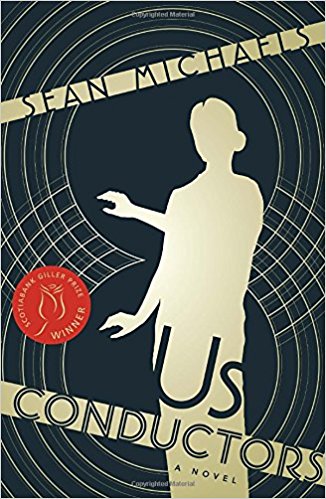
Us Conductors: “You are a lord of the air”
Where to begin with this strange novel, winner of the 2014 Scotiabank Giller Prize? Penguin Random House Canada calls it a “book of longing and electricity” and it is that — and so much more.
At its heart, it’s a love story and a beautiful one at that. Termin’s heart longs for Clara Rockmore with the poetic pulse of Humbert Humbert for his Lolita. Some of Michaels’ description and imagery is stunning as when Termin reminds his beloved of the time he saw her:
“When I found you on my doorstep in a red coat, leaning against the jamb, you seemed so at ease, so familiar with this place, with the sight of me, smiling, that it felt as if I had been the one who had forgotten you, Clara. You leaned like the hour hand on a clock.”
Clara was a violinist who excels on the theremin. Termin has heard others perform his instrument but they pale compared to her, he says:
“Every player of the space-control theremin draws his or her music from the same loose current, the same air, the same relationship of hands and antennas. We are all siblings, summoning the same songs. Somehow yours are more beautiful.”
But then, when you’re in love it seems that her every move is a musical masterpiece. Here is Termin, again, recalling one shared moment over a dish:
“Customers want to spend their nickels on delights. I put my hand on yours. The room shone white and felt like the future. You drew the spoon from your mouth, savouring tart and sunbright. There, your inclined jaw. We kissed.”
Us Conductors is more than a love story though. It’s a spy thriller, an immigrant’s tale, a story of invention and of an inventor. It’s also a tale of redemption and victory over the harshness of the gulag. And the compelling plot is in perfect harmony with the beauty of the writing.
For instance, one Soviet officer is described as slouching in his uniform “as if his epaulets forced him to lean forward.” Termin says with his experiments in radio, he felt “like an explorer who has only just glimpsed the outline of a continent.” Of his days in New York, Termin writes of learning about “numbers, diagrams,formulas” in a university library where “an idea is like glimpsing a person before she disappears around a corner. You must still learn her full figure.” Back in the Soviet Union, “in a bare room across the world,” Termin writes, “I leave commas on the pages,,,,,like eyelashes.”
Of his greatest achievement, Termin’s friend Pash — “bright eyes, a small mouth, a nose like a cudgel” — reminds him, “You’re a lord of the air, remember.”
Throughout its 368 pages, I only stumbled upon one awkwardly worded paragraph that could have used some help from careful editing. Termin repeats himself when telling Clara, “I imagined one morning you took a cab up to Harlem and got out where we used to get out sometimes, though you didn’t realize it until you got out, right into a puddle, looking down at your feet then lifting your gaze up to the orange awning, QUIET BARBERSHIP.”
Like one bad note in an otherwise perfect piece of music, the literary lapse is easily forgotten and forgiven.

Beethoven: The Man Revealed: “Nothing at all must chain me to life”
What John Suchet lacks in objective distance and subtlety, he more than makes up for in his enthusiasm for his subject.
And there is no shortage of Beethovian enthusiasm in the author and host of Classic FM. Parts of his writing are over-the-top in its hyperbole and almost fanboy thrill about one of the world’s greatest musicians, but it’s forgotten by the sweep of the story.
Beethoven’s life was one of great triumph and tragedy, as most people know. Chief among them was the cruelty that fate bestowed upon someone whose music was sublime by making him deaf at an early age. The tale of Beethoven’s “immortal beloved,” popularized in a very fine film starring Gary Oldman in the title role, is also well known.
Still, anyone wanting more of the finer details about Beethoven will not be disappointed in this story. What’s more, Suchet purposely set out to write a book for those who love Beethoven’s music instead of academics, and this biography is easily understood by readers who haven’t studied music.
First, an example of Suchet’s double-shot-adverb hyperbole so you know what you’re getting into:
“Extraordinarily, unbelievably, none of this hampered Beethoven’s creativity, and by early the following year he had completed the first of the string quartets, Op. 127,” he writes of the great composer’s struggles with his health and his nephew Karl.
In another passage, Suchet enthuses:
“Utterly extraordinary as it is to report (I know, I am repeating myself, but this is Beethoven), his appalling health did not stunt his creativity. That — again — is a small understatement. As his health plummeted, he began work on a new string quartet, which was to become Op. 131, and which musicologists today rate as the greatest of them all. He was to continue work on this quartet throughout the turbulent months that were to follow.”
What’s extraordinary about the life that Suchet portrays is Beethoven’s joy of, and fidelity to, his art. The composer has been portrayed as cantankerous and even impossible to bear, but despite his considerable health issues, deafness and personal traumas, his spirit was strong and resilient.
In one letter to Archduke Rudolph, after his return to Vienna in late 1812, Beethoven wrote:
“You may no longer be a man, not for yourself, only for others, for you there is no longer any happiness except in yourself, in your art — Oh God, give me strength to conquer myself, nothing at all must chain me to life — ”
Even in his dying days, Beethoven maintained a kind of purity of spirit and wise composure. The last musical notes he wrote to Karl was a four-bar canon on the words: ‘Wir irren allesamt, nut alle irrren anderset.’
In English, Suchet translates the words to: ‘We all err, but each one errs differently.’
In life, perhaps, but in his music Beethoven’s errors were few and far between.


 Claudio D'Andrea
Leave a comment