
A review of Surrender: 40 Songs, One Story by U2’s frontman
This book review was originally published on the Medium publication Literally Literary on Oct. 18, 2024.
“I’m having to subsume my ego because without their ability to express themselves I have nothing.
“Less than nothing.
“A void, a black hole.
“Today the only thing that’s on offer is a swollen ego.”
Bono is writing here about his bandmates in U2, and revealing his limitations as a musician in which he admits, “my grasp is a lot further than my reach. I can hear the music in my head, but I’m not able to play it.”
It’s a candid confession and one of many complimentary tributes he pays to the Edge, Adam Clayton and Larry Mullen Jr. in his 2022 memoir Surrender: 40 Songs, One Story. It’s also a confession of sorts about Bono’s own ego which may, or may not, play out in later pages as he recounts his political activism.
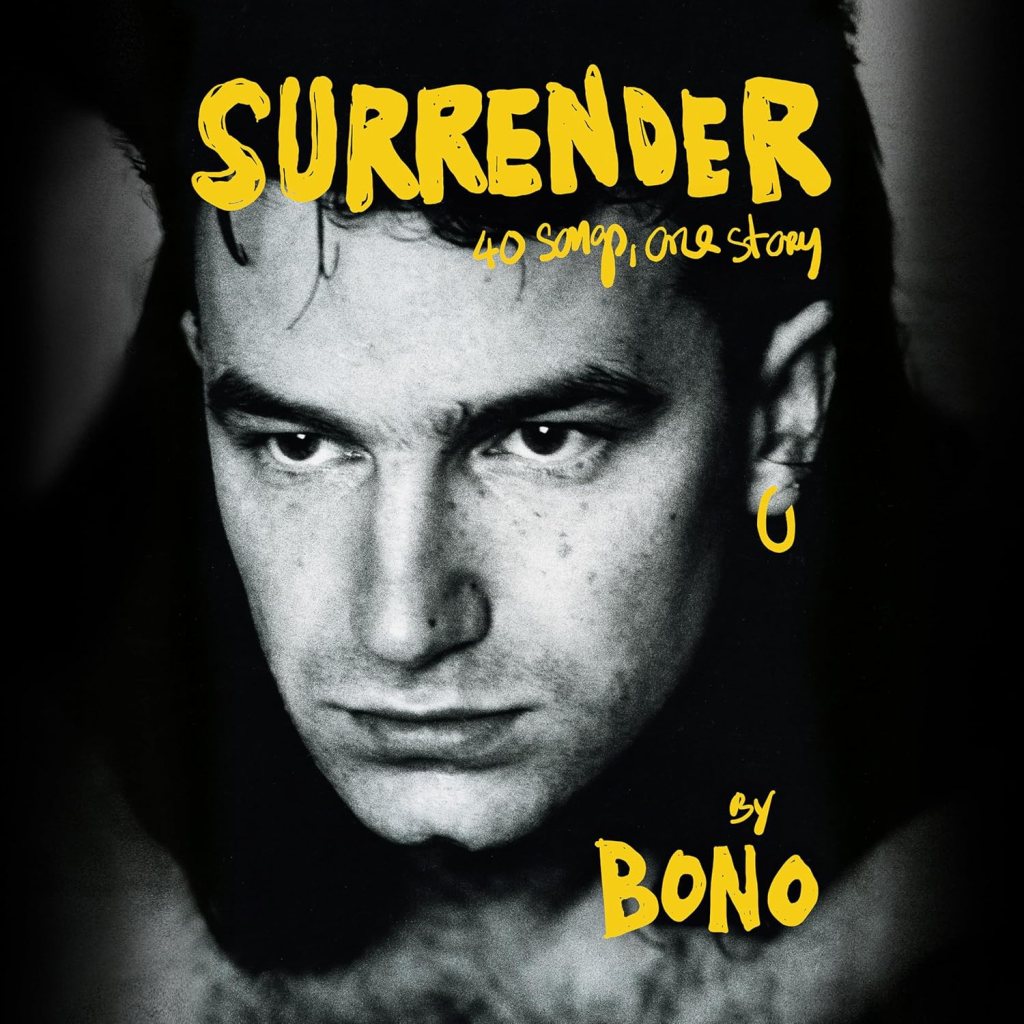
Let’s start by saying that Bono is a helluva writer. He’s also a great illustrator as shown in his work on the book jacket design and 40 illustrations that accompany each chapter.
If you’re approaching Surrender expecting you’ll learn about his personal story and especially the creative process and ups and downs in the band U2, you will get some of that. At least for about the first third of this 564-page book.
Bono writes about growing up in Dublin, Ireland and tragedies like losing his mother at age 14. He sings praises for his band and of his love for his wife Ali. He writes candidly about his anger issues, his faith and, of course, of music.
But if politics and music prove too heady a mix of musical biographies, you may be disappointed starting on, oh, say page 175.
That’s about when Bono begins writing about a long list of social and political causes he has been involved in and relating stories of the famous and influential whose paths he has crossed. I don’t think he’s name-dropping here and I would certainly not accuse him of having a messiah complex in saving the world. I find Bono’s many causes worthy and his zest and zeal authentic.
It’s just that I was expecting more insights about the band and their creative process. Instead, it seems Bono devotes a lot of ink to personal stories including the powerful movers and shakers of the world, as well as of musical stars and other celebrities.
Here’s a sampling of just some of the people he’s rubbed shoulders with in his quest for causes such as eliminating the debt of poor nations and AIDS. I probably left out some names but it should paint a picture of the people who filled his political stage over the years:
- Former British prime minister Tony Blair
- Bob Dylan, who asked Bono for an autograph which, he learned later, “was a very Bob Dylan thing to do, to turn the tables completely.”
- Bob Geldof
- Quincy Jones
- Ukrainian president Volodymyr Zelenskyy
- Mikhail Gorbachev
- Angela Merkel
- Bill Gates
- Wim Wenders
- The Dalai Lama
- David Bowie
- George Herbert Walker Bush
- William Jefferson Clinton
- Salman Rushdie
- Supermodels Christy Turlington, Helena Christensen and Naomi Campbell
- Michael Hutchence of INXS, a friend of Bono and Ali’s
- Frank Sinatra
- Luciano Pavarotti
- Princess Diana
- Pope John Paul II
- Harry Belafonte
- George W. Bush
- Dr. Condoleezza Rice, who Bono refers to as Condi
- George Soros
- Oprah
- Dr. Anthony Fauci
- Warren Buffett
- Ashley Judd
- Rupert Murdoch
- Steve Jobs
- Nelson Mandela
- Archbishop Desmond Tutu
- Barack Obama
- Paul McCartney
- The artist formerly known as Prince
- Tim Cook
- Johnny and June Carter Cash, and
- Patti Smith
If you can get past all those personalities and the politics, you just may find yourself mesmerized by Bono’s poetry and insights in this book. It really is a remarkable memoir and the unconventional way he organizes his chapters — little life stories written around 40 U2 songs — is compelling.
So is his obvious enthrallment to his muse. The opening quote notwithstanding, Bono is an outstanding artist and songwriter and he has paid more than his fair share of rent at the Tower of Song (with apologies to Leonard Cohen).
Consider this credo:
“Music for me has always been a lifeline in times of turbulence. It still is. That’s enough to justify its existence; the sacred service of getting a soul from there to here is not to be underestimated. Just giving someone a reason to get out of bed in the morning counts for so much. Music is the love that drives out all fear. Music is its own reason to exist.”
When it comes to faith, one thing I love about Bono is that it has always been strong but, to quote Cohen again, he needed proof. He also doesn’t foist his beliefs upon others, including non-believers.
Consider this statement:
“If I mostly find religiosity annoying, right up at the top of the annoying is the pigheaded certainty of the devout without the doubt. Not just no room for doubt in the God they follow, but no doubt in their ability to decipher the holy tracts. No doubt their version of events is the right one.”
Bono also recalls an encounter with Gorbachev in which he asks the former Soviet leader if he believed in God. Gorbachev responds: “‘No.’ (Long pause.) ‘But I believe in the universe.”
Surrender also offers a lot of laughter and humorous anecdotes. Bono tells the story of how he fell asleep in the Lincoln Bedroom of the White House after drinks and dinner with former president Barack Obama, the result of his allergy to salicylic acid which you find in wine and other foods and over-the-counter prescription medications. There are also the hilarious comments that Quincy Jones makes during an encounter with Pope John Paul II where he notes the great religious leaders’ loafers. ‘This is one stylin’ pontiff’,” the music producer legend says.
And there is no doubt of Bono’s gratefulness of his gift of music and how the world has rewarded him and his band. As he puts it:
“We who love what we do, and would do it for free, should never forget that we are 1 percent of the 1 percent of people who have ever lived. In history we hardly exist. To be this free of financial worry is the gift our audience gave to our band. To be free. To do what we love, to love what we do. Hardly anyone has lived like that. History has been a hard climb for our ancestors and getting up on two legs in black plastic pants doesn’t really compare, but I don’t want to forget that U2’s story is a freak of nature. A black swan event. Worlds have come crashing around the ears of more talented people than me, but since success first arrived for this band in the late 1980s, freedom has been our story and the story of our families. We owe a lot of that to you, whoever you are, reading this book.”
Amen to that!
@Claudio D’Andrea 2024
Claudio D’Andrea has been writing and editing for newspapers, magazines and online publications for more than 30 years and has published a book of short fiction, Stories in the Key of Song. Visit him at claudiodandrea.ca or read his stuff on LinkedIn and Medium.com and follow him on Twitter (now X).


 Claudio D'Andrea
Leave a comment