
The Certainty Illusion: What You Don’t Know and Why It Matters
This book review was originally published on Medium on March 3, 2025.

Science isn’t supposed to be this funny. Right?
Trying telling that to Timothy Caulfield.
Caulfield is a professor at the University of Calgary Faculty of Law and School of Public Health, and research director at the Health Law Institute at the University of Alberta. He writes about stem cells, genetics, research ethics and more, all subjects covered in his 2025 book The Certainty Illusion: What You Don’t Know and Why It Matters.
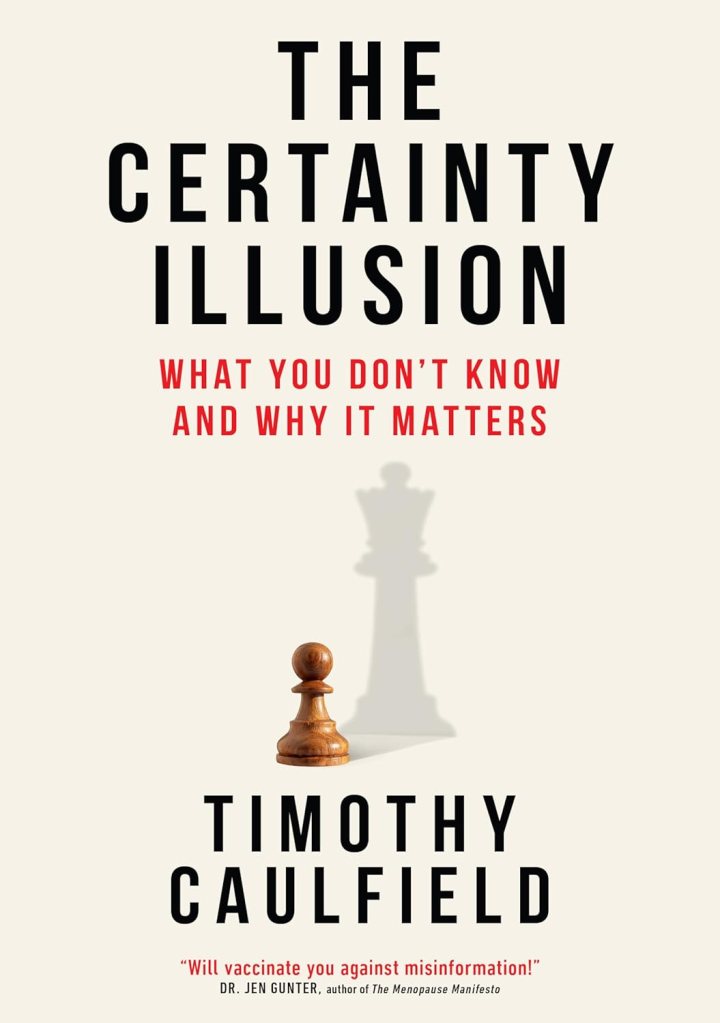
The subject matter is serious stuff. In a nutshell (I would share a funny quote about that but it would crack you up), he’s writing about truth and how to spot fakes and manipulation.
But he does it while dropping so many sarcastic, seemingly flippant comments that you sometimes forget he’s being serious.
Not that the world’s greatest scientists lacked a sense of humour. Isaac Newton once quipped (or did he?): “I can calculate the motion of heavenly bodies but not the madness of people.” Albert Einstein did one better: “Two things are infinite: the universe and human stupidity; and I’m not sure about the universe.”
Caulfield seems to be having so much fun with being funny that you forget you’ve just finished 237 pages, and learned a lot about things you’ve taken for granted as the truth.
Let’s start with Dr. Olivia Doll. She’s a celebrated authority — an editor and writer who sits on the editorial boards of seven academic journals. She’s also a Staffordshire terrier named Ollie and her Doll alter-ego is the brainchild of Mike Daube, a public health research at Curtis University in Australia.
Daube created Doll, with her fake credentials, to demonstrate the lack of credibility of “predatory journals.” That’s what Caulfield calls so-called scientific journals that sound legitimate but publish spurious research with little or no oversight, as illustrated in the Doll example he cites.
Caulfield, who quips homeopathy is “the air guitar of biomedicine,” tried his own little experiment after being invited by one such journal to submit a manuscript. It fit on one page and was made up of the repeated lines: “Homeopathy is pseudoscience BS.” When the editor responded the next day that his paper received preliminary acceptance and then a few months later let him know it was too short, Caulfield added “that’s all that needs to be said about homeopathy.” He considered following that up again by copying his original phrase 300 times but decided he had had enough fun and that the “jig was up.”
He also cites the example of a long-dead researcher whose work was accepted by another publication in a book that cautions us about all the ways we are deceived.
Caulfield breaks down these illusions into three areas: scientific reports and writing, “the goodness” industry and the “opinion illusion.”
Among the subjects he covers in the second category are many health claims made on behalf of food, and health and beauty products. Some of them are downright dangerous, like radium water which contains actual radium and is radioactive. Grain-free pet food and parabens are other subjects covered in this section.
And don’t get Caulfield started on anti-vaxxers and Gwyneth Paltrow. The actor once released a product called “This Smells Like My Vagina,” a scented candle she peddled to women that smells like…yeah, you guessed it.
Men can’t escape Caulfield’s sarcastic cuts either. In skewering the “manly man” craze he ridicules Tucker Carlson’s endorsement of testicle tanning. I wish (and I’m sure Caulfield agrees) I was making this up.
The last section covers subjects like product reviews and the so-called wisdom of the crowds. Here he writes about how often we’re duped by fake reviews and those bought by companies or used to sabotage their competitors.
All of this can sound so cynical and hopeless. Caulfield encourages us not to despair but to arm ourselves with knowledge and common sense. “Be open to the wonder, but not closed to the facts,” he writes.
He concludes with some suggestions about how individuals and governments can eliminate some of the illusion in our lives. It’s a hopeful path forward and I do want to believe him.
I want to hang on that hope even as I think about how more than 77 million Americans dismissed a torrent of lies, deceit and corruption to elect one Donald J. Trump.
Maybe Einstein wasn’t being funny after all.
Claudio D’Andrea has been writing and editing for newspapers, magazines and online publications for more than 40 years and has published a book of short fiction, Stories in the Key of Song. Visit him at claudiodandrea.ca or read his stuff on LinkedIn and Medium.com and follow him on BlueSky and (for now) Facebook.


 Claudio D'Andrea
Leave a comment