
Joseph Heath’s Enlightenment 2.0: Restoring Sanity to our Politics, Our Economy, and Our Lives
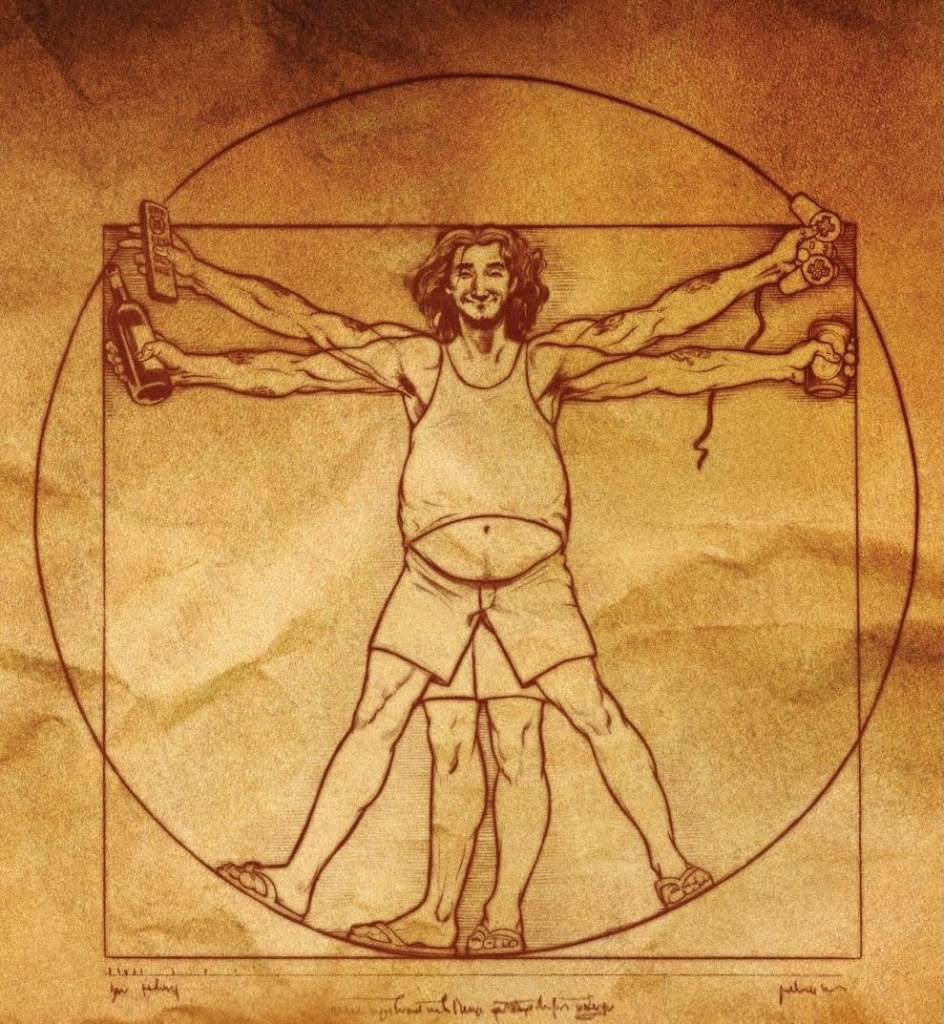
Poster for the movie Idiocracy turns Vitruvian man into modern slob man.
Originally published on Medium.
Partway into Joseph Heath’s Enlightenment 2.0: Restoring Sanity to our Politics, Our Economy, and Our Lives, the author and University of Toronto philosophy professor provides an example of “warp thinking” that opens the reader’s mind.
Taking his cue from American psychiatrist George Ainslie, Heath explains how if offered a cheque for $100 to cash right away or $200 in two years, most people would take the $100. But if offered a $100 cheque in six years or $200 in eight years, many would take the second option.
The difference in years — two — is exactly the same. So why do most people decide to delay in the second scenario?
“The ‘warp’ in the way in which we evaluate the future has the potential to create an enormous amount of misery,” Heath says. It explains why we adopt many “bad habits,” from staying up late or saving too little for retirement and putting off a colonoscopy, he writes.
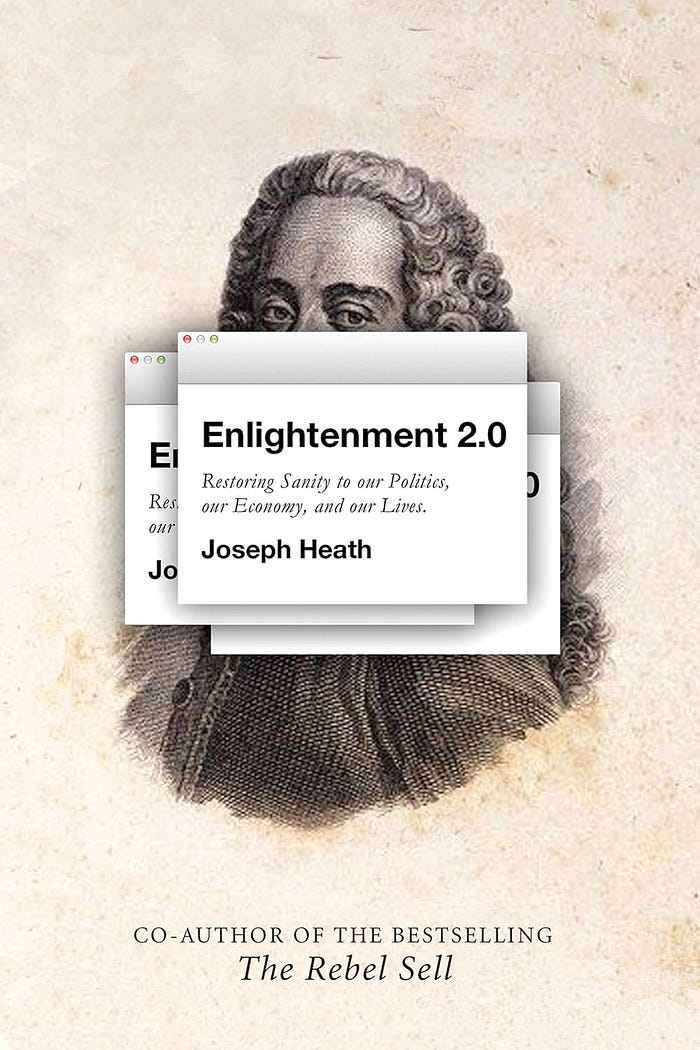
The example that he provides is lucid and, well, enlightening. Heath’s book is a tonic for those who long for sanity in our world.
Still, I can’t help but think our world has already veered too far off from sanity and we won’t be able to find our way back. Written in 2014, before Trump 1.0 and 2.0, Heath’s book in some ways already feels like a reminder to a quainter time when someone like George W. Bush trolled the depths of political incompetence.
Yet Heath was already writing at a time of the Tea Party and “truthiness” where our politics and civil society were already being debased. Indeed, in explaining the concept coined by Keith Stanovich as “dysrationalia” — the “inability to think and behave rationally, despite adequate intelligence” — Heath points out that Bush actually had a higher grade average from Yale than John Kerry. That kind of intelligence run amok is used to cite other examples of dysrationalia in society, like the retired engineer who becomes a 9/11 truther.
Heath does a good job in explaining the human conflict between heart and head, or intuitive versus rational types of thought. Unfortunately for us, intuition has been like an tsunami over rationality, washing away reason and leaving behind the detritus of dumbness.
Take the movie Idiocracy. Heath writes how the 2006 satirical comedy skewered politics and modern consumer society in its vision of an America of the future where there are only idiots who run the show. The sad reality, he says, is that “most of the time the film seems like it’s set fifty years in the future, not five thousand.”
He cites examples of the U.S. Republican Party that once put forward candidates who were highly educated but were good at pretending to be poorly educated as a way to win votes, to his time of candidates who were “genuinely uneducated.” He uses the example of Sarah Palin.
Alas, that was then. Today, we have Trump as proof of Heath’s truth.
Heath doesn’t just write about American politics and society. A Canadian, he provides many examples from north of the border about how his country is also veering toward idiocracy.
His solution is to embrace rationality by adopting a mindset similar to the “slow food” movement. Founded by Carlo Petrini in Italy in 1986, it was a reaction to the fast food culture and it promoted food quality over quantity instead of overproduction and food waste.
Heath argues for a “Slow Politics Manifesto” which he describes as “quiet, rational deliberation” as “the only way to oppose the universal of Fast Life.”
In our social media-saturated, highly polarized and twitchy-trigger finger reaction world, a cynical reader may be tempted to ask how we can find our way off the fast lane. But Heath remains the optimist. As he puts it:
“It is important to remember that rationality is not some alien set of rules imposed on us from on high; it is, rather, the basis of human freedom and autonomy. It is the set of rules that we follow when we want our beliefs to correspond to reality, when we want to avoid failure in the pursuit of our objectives, and when we want to agree on principles for living life in common.”
Claudio D’Andrea has been writing and editing for newspapers, magazines and online publications for about 40 years and has published a book of short fiction, Stories in the Key of Song. Visit him at claudiodandrea.ca or read his stuff on LinkedIn and Medium.com and follow him on Bluesky.


 Claudio D'Andrea
Leave a comment