
Anne Baldo’s debut short story collection Morse Code for Romantics
Originally published on Medium on Apr. 20, 2026.
How good is the writing? This good:
“I read once that’s the word most said before we die: mama, mother. Who had recorded this? But still, I could believe it. Our first word, our last.”
I first discovered the author Anne Baldo in her interview with local poet and writer Vanessa Shields. Baldo hails from my hometown of Windsor, Ontario “in the furthest reaches of Southwestern Ontario” as her book jacket bio says, and she struck me as very quiet, introspective and humble in the video. I loved the title of her 2022 book of short stories Morse Code for Romantics so I went to the Indigo store at Devonshire Mall and picked up a copy.
It’s a helluva debut from the long-listed candidate of the 2019 CBC Nonfiction prize for her story Expecting.
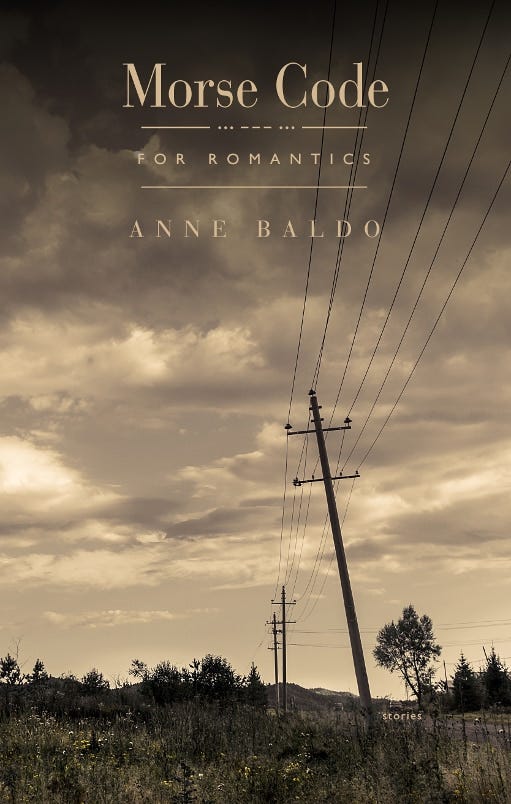
There is so much to unpack in the 14 short stories that make up Morse Code for Romantics that it’s hard to know where to begin. When I read a book I like I have a habit of noting by a pencil dot (my own Morse code!) a word, line or passage that resonates for me. It could be something beautifully written or wise or eye-opening. I then note the page numbers on a blank sheet of paper that I place at the back of the book so I can refer to them later.
In Baldo’s book, I ended up with two pages of notes.
Let me start with the quality of writing. I’ll begin with the title story and this reference to one of her characters:
“I think of Livvy not in this white dress. In the clothes I know her in. Blue flannel and old jeans. Or getting ready to go out for the night, in what she called a black cami dress that looked like a slip. Double-strap Mary Jane heels and red lipstick gleaming like the last lick of jam in the jar.”
Baldo alludes to the wonderful title imagery of hers in another story, “Monsters of Lake Erie,” by noting that, “The truly lonesome have a sort of code, written in their faces. I do believe that. Silent as sonar, as the lights of Morse messages.” That story also has another beautifully written passage when she describes the scene of her Southwestern Ontario setting: “It was spring and the grass was green again, but the trees were dark, a thousand black stitches against the sky. The cutwork of angels.”
In another wonderfully titled story “Fish Dust” (it’s a malapropism of one of her characters), here’s another bit of word wizardry that harkens to Shakespeare’s famous “lean and hungry” line from Julius Caesar:
“With dark heavy brows, a slight slant to the mouth, sharp teeth, and a lean jaw, he had a lupine look that would show up in my half-brothers one day, that was already beginning to shape True’s teenage features. A sullen mouth, a hungry face.”
In “Songbirds of Southern Ontario,” Baldo’s astonishing imagery describes what it must feel like to be born by Caesarian section:
“The blinding light, the doctor’s gloved hands tugging her up towards it. It would probably be a lot like the experience of people who claimed aliens had abducted them, that sudden snatching from above, the medical prodding, and I felt a new rush of sympathy for them, although Aidan always maintained it was impossible.”
Even something as quotidian as the names of bird species sound poetic coming from the pen of Baldo. Like this passage from “Last Summer”:
“There are 338 species of hummingbirds. Their names are striking — sunangel, glittering-throated, violetear. Brilliant, they shine with gemmed agility, their needs so wild they fall into a state called torpor, in which they’re not dead but not alive, not really, a sort of hibernation where their hearts calm down, their breathing slows, and they finally get a chance to rest.”
“Marrying DeWitt West,” one of my favourites in this collection, is a satisfyingly creepy tale reminiscent of Rebecca and Lolita. This story of the “Beast of Isle aux Morts” in Newfoundland, as the newspapers called the mysterious sea creature that was dragged up to the surface of the water during a summer storm, provides some gems as: the face of a girl “shaped like a broken heart;” a man’s elegant voice “fine as violin strings;” and a white sky “piercing with gulls.”
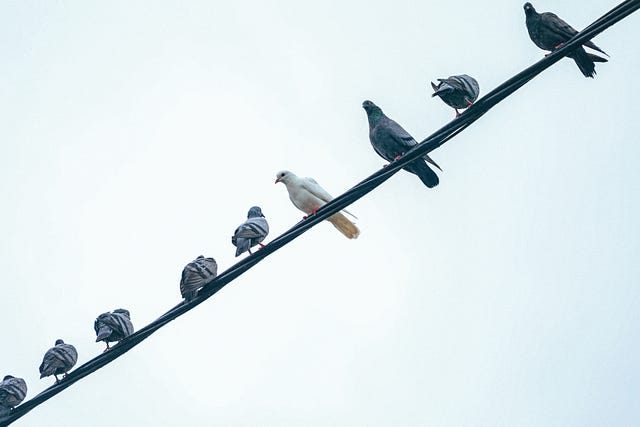
Birds play a big part in this book, particularly those on a wire which is also an illustration that appears at the top of every story. We see it in “Oh How We Miss You. How About Joining Us?” when she refers to a postcard on a wall showing “four cartoon birds on a wire, pop-eyed, open-mouthed, tweeting away. Oh How We Miss You, they sang. How About Joining Us?” In “Motel Mermaids,” Baldo writes of a flock of mourning doves watching from a telephone wire, “cooing gloomily.”
Another recurring motif in this collection is that of things falling from the sky to earth. In “Songbirds of Southern Ontario,” for instance, she refers to the Grimm Brothers tale of the stars taking pity on an orphan girl who gives away everything she has and falling to earth as silver coins. In “First, Do No Harm,” the character Ophelia tells Tamás that sometimes you can hear a meteorite fall.
Some stories also share references to popular figures from the past like Elvis Presley and James Dean. They provide a warm nostalgic glow to some of the writing like this line from “The Way to the Stars”:
“I was so tired, and I couldn’t understand why. Six o’clock and I felt my eyes keep sliding shut, like those old baby dolls they used to have, with the blinking eyes that closed when you tilted them.”
Besides some of the beautiful writing, there are wise and wonderful lines that stay with you in Morse Code for Romantics. Like this one from another wonderful (yet oddly utilitarian) titled story “Incendiary Materials for the Purpose of Arson”:
“A void is not peace. Nothingness is not the same as happiness.”
In the last story “Wishers,” the character “Demetria” says, “I read once that’s the word most said before we die: mama, mother. Who had recorded this? But still, I could believe it. Our first word, our last.”
Or, in “The Happiness of Robots,” Baldo writes:
“The years alter memory like a prism alters light, fracturing it the way the branches of the trees above broke the last sunlight into pieces, until all that’s left is broken.”
The brokenness of some characters and their self-awareness are evident in some stories. “Last Summer,” for instance, meandered a bit but ends beautifully with the main character declaring, “I want my life to have a motif. I want my life to have a pattern. Instead, I feel I exist in chaos.”
Something else that drew me to this collection were the familiar local touches in Baldo’s writing. These are places I’ve seen and visited. A lot.
There are the descriptions of places like Point Pelee. The reference to La Stella market on Erie Street which still sells food to the local Italian population. And there’s Ophelia in “First, Do No Harm” recalling the lights in the Windsor-Detroit tunnel.
Morse Code for Romantics is a collection that sends all the right signals; they stay with you long after you’ve closed the book. If there was something I’d like to ask the author though, it’s this strange motif: the clenched butt. One character remarks that you could keep yourself from crying if you did that but “you can’t go around clenching all day.”
That signalled a loud guffaw along with an, ‘Um, what?”
Claudio D’Andrea has been writing and editing for newspapers, magazines and online publications for about 40 years and has published a book of short fiction, Stories in the Key of Song. Visit him at claudiodandrea.ca or read his stuff on LinkedIn and Medium.com and follow him on Bluesky.


 Claudio D'Andrea
Leave a comment